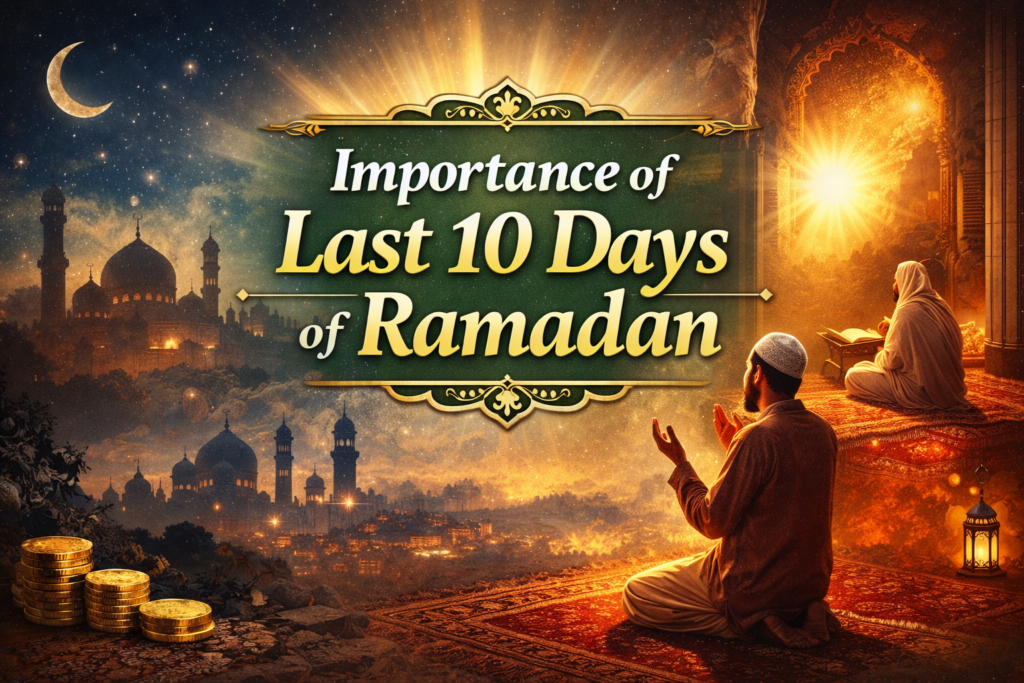
The entire month of Ramadan is filled with Allah’s mercy and countless blessings. However, the last ten days of Ramadan hold a special and unmatched importance in Islam. As this sacred month draws closer to its end, the doors of Allah’s mercy, forgiveness, and divine blessings are opened even wider, offering believers a final and powerful opportunity for spiritual renewal.
For this reason, Muslims around the world strive to increase their worship, supplication, and closeness to Allah during these final days. They seek the immense rewards Allah has promised to His servants, hoping to attain His forgiveness, mercy, and nearness before the blessed month of Ramadan comes to an end.
In this article, we will discuss in detail the last ten days of Ramadan, Laylat al-Qadr, its significance in Islam, the Sunnah practices the Prophet ﷺ observed during these blessed days, and, finally, the recommended du‘a of the last ashra of Ramadan.
What Is the Last Ashra of Ramzan?
Ramadan is traditionally divided into three ashras, each consisting of ten days, and each carrying its own spiritual significance. These ashras are understood as:
- First Ashra – Mercy (Rahmah)
- Second Ashra – Forgiveness (Maghfirah)
- Last Ashra of Ramadan – Protection from Hellfire (Najaat)
The third ashra of Ramadan includes the last ten days, sometimes nine, beginning from the night of the 21st Ramadan and continuing until the moon of Shawwal is sighted. It is the period of salvation from Hellfire and Allah’s greatest forgiveness. This ashra holds special importance in Islam, as it includes Laylat al-Qadr, the blessed night in which the Qur’an was revealed to the Prophet ﷺ.
These final days and nights offer believers a powerful opportunity to seek Allah’s mercy, forgiveness, and protection, making them the most spiritually intense period of the month.
Significance of the last 10 days of Ramzan
The last ashra of Ramadan holds a unique and highly special place in Islam. The main reasons for the significance of these final ten days include:
- The Night of Decree – Laylatul Qadr
The greatest reason for the importance of the last ten days is Laylat al-Qadr (the Night of Decree), which occurs on one of these nights. This blessed night is when sins are forgiven, supplications are accepted, and Allah’s mercy and blessings become countless. This night is a gift from Allah to this Ummah.
Allah says:
“The Night of Decree is better than a thousand months.”
(Surah Al-Qadr 97:3)
This verse highlights the immense rewards of Laylat al-Qadr, showing that worship performed on this single night surpasses the reward of a lifetime of devotion.
The Prophet ﷺ said:
“Seek the Night of Qadr in the odd nights of the last ten days of Ramadan.”
(Sahih al-Bukhari, 2017)
This Hadith indicates that Laylat al-Qadr falls on one of the odd-numbered nights—the 21st, 23rd, 25th, 27th, or 29th of Ramadan.
The Prophet ﷺ said in another hadith:
“Whoever stands (in prayer) during Laylatul Qadr with faith and seeking reward, his previous sins will be forgiven.”
(Sahih al-Bukhari, 1901
The immense virtue of this night makes the last ashra of Ramadan more valuable than a lifetime of ordinary worship. It is a time when sincere devotion, prayer, and supplication are rewarded beyond measure, urging believers to intensify their acts of worship during these blessed nights.
- Revelation of the Quran
Another reason the last ashra of Ramadan holds special importance is that the Qur’an was revealed during these blessed ten days, on Laylat al-Qadr.
Allah says:
“Behold, We revealed this (Qur’an) on the Night of Power.”
(Surah al Qadr 97:1)
This connection between the Quran and the final days of Ramadan makes them more significant than the earlier days of the month. Believers are therefore encouraged to engage deeply with the Quran during this sacred period.
The Sunnah Practice of the Prophet ﷺ in the Last 10 Days
The Prophet ﷺ gave great importance to the last ten days of Ramadan. The following are some of the Sunnah practices He observed during this blessed period:
- Increased Worship and Effort
During the last ten nights of Ramadan, the Prophet ﷺ would focus intensely on worship, distancing himself from all worldly distractions and dedicating his time entirely to devotion.
Hazrat Aisha RA said:
“When the last ten nights began, the Prophet ﷺ would tighten his waist belt, stay awake at night, and wake his family.”
(Sahih al-Bukhari, 2024)
This Hadith highlights the special importance of these ten days. The Prophet’s ﷺ actions show that worship during this period goes beyond routine practices; extra effort, sincerity, and dedication are part of the Sunnah, guiding believers to maximize their spiritual gain during these blessed nights.
- I‘tikaf – Seclusion for Allah
I‘tikaf is the act of retiring to the mosque for worship, dedicating time solely to Allah while remaining free from worldly distractions. This practice is part of the Sunnah of the Prophet ﷺ.
Hazrat Aisha (RA) reported:
“The Prophet ﷺ used to practice I‘tikaf in the last ten days of Ramadan until he passed away, and then his wives continued the practice after him.”
(Sahih al-Bukhari, 2026)
Authentic Dua for Last Ashra of Ramzan
The most authentic and highly recommended du‘a for the last ashra of Ramadan was taught directly by the Prophet ﷺ. He ﷺ specifically taught this du‘a to his wife, Hazrat Aisha (RA), guiding believers on how to seek Allah’s mercy, forgiveness, and blessings during these final, sacred days of Ramadan.
اللَّهُمَّ إِنَّكَ عَفُوٌّ تُحِبُّ الْعَفْوَ فَاعْفُ عَنِّي
“O Allah, You are Most Forgiving, and You love forgiveness, so forgive me.”
(Tirmidhi, Ibn Majah – Sahih)
Worships to Focus on in the Last 10 Days of Ramadan
Muslims should focus on the following acts of worship during the last ten days of Ramadan, especially on Laylat al-Qadr:
1. Night Prayer (Qiyam & Tahajjud)
2. Qur’an Recitation With Reflection
3. Constant Dua and Istighfar
4. Charity (Sadaqah)
FAQs –
1. Why are the last 10 days of Ramzan so important?
because they include Laylat al-Qadr, the blessed night on which the Quran was revealed and during which sins are forgiven.
2. Is I‘tikaf mandatory?
No, I‘tikaf is not mandatory, but it is a highly emphasized Sunnah of the Prophet ﷺ
3. Is Laylatul Qadr Only on the 27th Night of Ramadan?
Laylat al-Qadr does not necessarily fall on the 27th of Ramadan. The Prophet ﷺ instructed that it should be sought in the odd nights of the last ten days of Ramadan.
4. What is the best dua for the last ashra of Ramadan?
The dua taught by the Prophet ﷺ:
Allahumma innaka ‘afuwwun tuhibbul ‘afwa fa‘fu ‘anni.